
The Pressure-Washing Mistakes Pros See on Repeat (and how to stop making them)
Pressure washing looks simple right up until it isn’t. One bad choice with pressure, nozzle, or chemical, and you’re not “cleaning”, you’re carving, flooding, bleaching, or peeling someone’s property in real time.
I’ve watched good operators get humbled by a soft cedar board and I’ve watched rookies “solve” algae by blasting it deeper into porous concrete. Same story, different zip code.
The bill shows up later: what mistakes really cost
Most pressure-washing errors don’t feel expensive when they happen. They feel *fast*. And that’s the trap.
Rework is the obvious cost: extra labor, extra chemical, extra fuel, extra wear on the pump. The quieter cost is reputational. In residential work, a single “you etched my driveway” post in a neighborhood group can put you in a hole you didn’t dig with your wand. That’s especially true when you’re serving the kinds of customers outlined in Who Needs Pressure Washing?
And yes, there’s data behind the safety side of this. The U.S. Consumer Product Safety Commission estimates ~6,000 pressure-washer related injuries per year treated in emergency departments (CPSC estimate cited by multiple safety summaries; see CPSC pressure washer safety communications and injury surveillance reports). That’s not a “be careful” poster. That’s reality, lacerations, injections, eye injuries, slips.
Now, this won’t apply to everyone, but if you price jobs assuming everything goes right, you’re basically betting your profit margin against physics.
Hot take: PSI is overrated. Flow and control win jobs.
People love to brag about PSI. Pros obsess over GPM.
Here’s the thing: a higher flow rate (GPM) moves more water and rinses suspended dirt faster. PSI is what damages surfaces when you concentrate it poorly. The sweet spot is usually “enough pressure to break the bond, enough water to carry it away.”
If you’re buying gear, you’re not buying “power.” You’re buying *repeatability*.
A practical setup mindset I use:
– Start with versatility (a machine you can throttle and pair with different nozzles)
– Add a pressure gauge at the gun if you’re serious about consistency under load
– Invest in hoses and fittings that don’t lie (cheap couplers leak, then whip, then ruin your day)
One-line truth:
You can’t clean professionally with hobby-grade reliability.
The part everyone skips: site assessment (aka “what am I about to damage?”)
Sometimes I do this in 90 seconds. Sometimes it takes 10 minutes. Either way, I do it.
What I’m scanning for:
– Surface type + condition: oxidized paint, punky wood, spalling concrete, loose mortar, failing sealers
– Water behavior: where runoff is going, what it touches, where it pools
– Electrical + openings: outlets, soffit vents, door sweeps, garage seals
– Wind and drift: chemical mist finds cars like it’s guided by GPS
– Plants: not just “cover them,” but “can I rinse them continuously?”
And yes, I test a hidden spot. Always. Not because I’m timid, because I like keeping my money.
Nozzles, angles, and distance: the “damage triangle”
If you only remember one concept, make it this: damage is rarely just PSI. It’s PSI *plus* nozzle *plus* distance *plus* dwell time in one place.
A few field rules that hold up:
Concrete (flatwork):
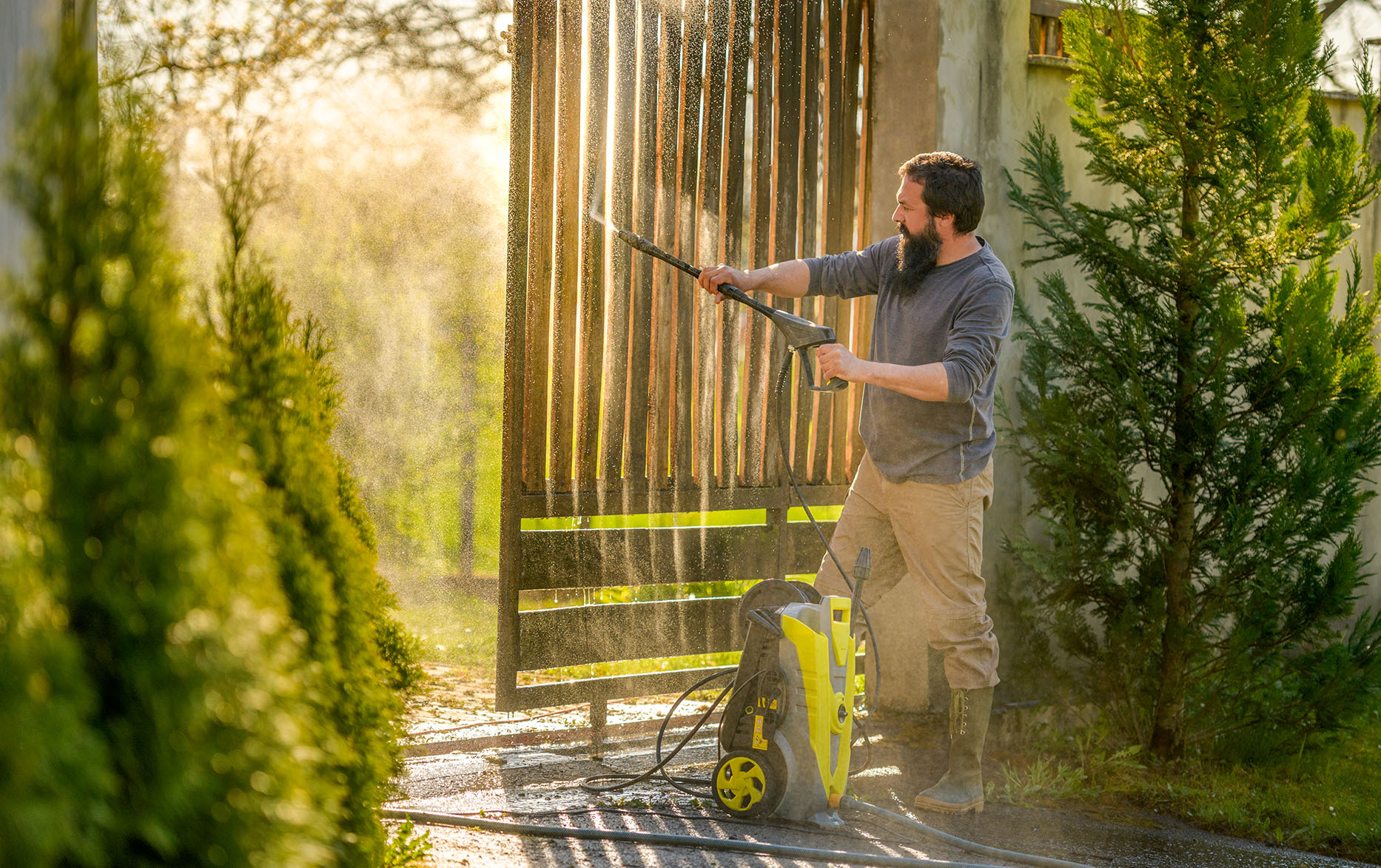
Use a wider fan tip (25° or 40°), keep moving, and don’t “write your name” with the spray. Etching happens when you stop or overlap too tightly. For big areas, a surface cleaner beats a wand in both finish quality and speed.
Wood decks:
Lower pressure, wider tip, longer distance. Aim with the grain when possible. If you’re raising fuzz, you’re not “deep cleaning”, you’re sanding with water.
Siding (vinyl/aluminum):
Moderate pressure, wider spray, and watch the angle. If you push water up under laps, you’ve just volunteered for a moisture problem (and an angry call-back).
Brick/stucco/old masonry:
Treat it like it’s fragile even when it looks tough. Stay off the surface, keep angles conservative, and avoid zero-degree hero moves. Mortar joints lose arguments with concentrated spray.
One small technical note: approach angles in the 45° range tend to lift contamination without driving water straight into seams. Straight-on blasts feel effective and look dramatic, but they’re often the start of intrusion.
Chemicals: where “more” makes you worse
Detergent is not seasoning. You don’t eyeball it.
Over-strong mixes cause streaking, plant damage, and weird “shadow” patterns that show up after drying. Under-mixed product wastes time because you compensate by cranking pressure, which is how siding gets zebra stripes and wood gets shredded.
In my experience, the best results come from being boring:
– match chemical to soil (organic growth vs grease vs rust vs tannins)
– respect dwell time
– rinse like you mean it
And don’t get cute mixing products (bleach + acids is a classic example of “you may not enjoy the outcome”). Read labels. Follow local disposal/runoff rules. The job isn’t done if you’ve killed someone’s landscaping or sent suds to a storm drain.
Prep and protection (the unglamorous stuff that makes you look like a pro)
This section is short because it’s simple.
Cover what matters. Wet what can’t be covered. Move what can be moved.
A quick pre-spray routine I like (and yes, I actually follow it):
– verify nozzle is what you think it is
– check hose routing so you’re not creating trip hazards
– confirm shutoff works and gun trigger isn’t sticking
– pre-rinse plants and keep them damp during chemical use
– close windows, protect outlets, block delicate areas
Look, customers don’t notice prep when it’s done right. They notice it when you don’t do it.
Safety isn’t a paragraph, it’s a system
You’re handling high-pressure water that can cut skin, chemicals that can burn, and surfaces that get slick fast.
Wear PPE that fits. That last part matters more than people admit (loose cuffs snag, foggy goggles get removed, gloves that don’t seal get you chemical wrist tattoos).
Minimal PPE that’s hard to argue with:
– sealed eye protection
– chemical-resistant gloves appropriate to the product
– non-slip boots
– hearing protection if you’re running loud units all day
– respirator when you’re atomizing harsh chem in enclosed or low-airflow areas
If you work with a crew, have a basic emergency plan. Who shuts down the machine? Who calls? Where’s the rinse water? It feels dramatic until it isn’t.
Edge work, overlap, and the “rushing tax”
Rushing doesn’t just cause misses, it creates *patterns*. Wand marks. Stop-start lines.Halos.Those weird clean stripes that scream “DIY.”
Best technique advice I can give in one breath: consistent distance, consistent speed, consistent overlap.
On long runs, I aim for deliberate passes with slight overlap, and I don’t chase tiny spots mid-pass. Finish the pass, then touch up. Your results look cleaner because they’re uniform, not because you nuked every molecule of dirt.
Also: temperature changes behavior. Hot water helps on grease and some heavy soils, but heat plus the wrong chemical plus the wrong surface can go sideways fast (softened coatings are a thing).
Maintenance and follow-up: the pro move customers never see
Post-job inspection catches the stuff that turns into call-backs.
My rhythm:
A quick walk-around. Photos if something looks borderline. Then I check the machine like I’m trying to keep it for ten years.
Weekly-ish maintenance that pays back:
– clean or replace inlet filters
– inspect hoses and O-rings
– purge chemical lines
– check tips for wear (a worn nozzle changes output more than people think)
– verify pressure under load against your baseline
And I follow up within 24 hours when possible. Not with a scripted message, just a “How did it dry? Any spots you want me to hit?” That’s how you catch issues early and look confident, not defensive.
The real separator: consistency
Anyone can blast a surface. The pros deliver the same outcome across different materials, weather, water supply quirks, and job-site chaos.
Calibrate pressure to the surface. Test hidden areas. Use the right nozzle. Respect chemistry. Protect the site. Stay alive.
Then do it again tomorrow with the same discipline. That’s the whole game.
